Biruni Robotics
ARIA. Autonomous Risk Inspection & Assurance.
ARIA continuously detects material changes and anomalies in pledged stock.
ARIA uses forward-deployed autonomous robots on behalf of banks and collateral managers to patrol warehouses and create a continuous, independent record of physical collateral. The system operates throughout the day, identifying changes and anomalies that may require further investigation.
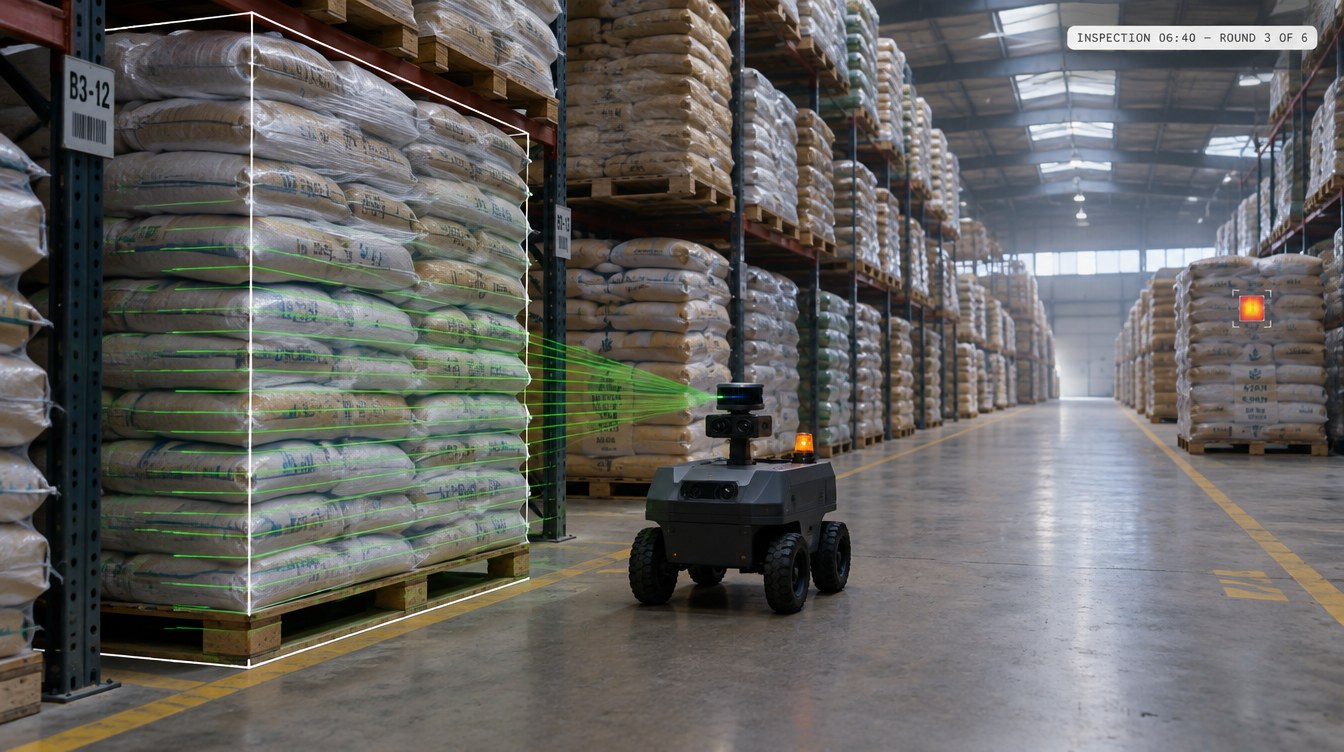
How ARIA works
Patrol → Capture → Detect → Report.
Patrol
ARIA autonomously conducts scheduled inspection rounds throughout the warehouse.
Capture
Visual, thermal and spatial sensors create a timestamped record of pledged stock and its surroundings.
Detect
ARIA compares each inspection against previous rounds to identify material changes and anomalies.
Report
Exceptions are automatically recorded and surfaced to the bank or collateral manager for review.
Core features
Autonomous patrols and charging
ARIA independently follows scheduled inspection routes and returns to its charging station between patrols.
Visual and 3D recording
Every inspection creates timestamped visual evidence and an updated spatial map of pledged stock.
Physical change detection
ARIA identifies material changes in the size, shape and position of pledged stock between inspections.
Unexplained movement alerts
Significant stock movement between inspection rounds is automatically flagged for review.
Thermal and visible anomaly detection
ARIA identifies unusual heat signatures, water ingress, damaged packaging and other observable abnormalities.
Independent audit trail and dashboard
Banks and collateral managers receive a continuous record of inspections, exceptions and historical changes.
Bank dashboard
A continuous view of pledged collateral.
ARIA gives banks and collateral managers a simple dashboard showing what has changed, what requires attention and the inspection history behind each warehouse. Built for a credit or collateral team, and readable in five seconds.
| Warehouse | Last inspection | Status | Open exceptions | Latest material change | Visual |
|---|---|---|---|---|---|
| Karachi Port — W2 | Today 06:40 | Normal | 0 | None since 12 Sep | Compare → |
| Rotterdam — Hall C | Today 05:15 | Attention | 2 | Stack B7 moved · thermal anomaly | Compare → |
| Felixstowe — Unit 4 | Yesterday 22:05 | Normal | 0 | Stock reduced 8% (documented) | Compare → |
Current warehouse status. The latest inspection and any outstanding exceptions.
Recent changes. Material changes in pledged stock since the previous inspection.
Exception alerts. Unexplained movement, thermal anomalies, visible damage and water ingress.
Inspection history. A complete timestamped record of autonomous patrols and findings.
Visual evidence. Before-and-after images and relevant 3D views for flagged events.
Portfolio view. One view showing which warehouses are operating normally and which require attention.
Problems ARIA solves
Limited visibility between inspections
Banks rely on periodic physical checks. ARIA provides continuous visibility between those inspections.
Unexplained stock movement
ARIA flags material changes in the position, size or shape of pledged stock.
Reliance on manual observation
ARIA follows the same inspection process repeatedly and objectively.
No continuous physical record
ARIA creates a timestamped visual and spatial history of the warehouse.
Slow identification of anomalies
Water ingress, visible damage, thermal anomalies and stack movement can be surfaced earlier.
Dependence on reported information
ARIA provides an additional independent layer of physical evidence for banks and collateral managers.
Designed for institutions
Banks
Monitoring pledged stock underlying lending facilities.
Collateral managers
Adding continuous machine-generated verification between physical inspections.
Financial institutions
Monitoring physical assets across multiple warehouse locations.